Monday, January 24, 2011


Sunday, January 23, 2011
The Fly Porsche 917/10 Interserie 1974
 |
| The Fly Porsche 917/10K Interserie 1974 |
General specifications:
Country of origin - Germany
Chassis number - 917/10-007
Numbers built - N/A
Produced in 1972
 |
| Enzo's Garage at Amazon.com http://www.amazon.com/shops/slots |
 |
| The Porsche 917/10K Interserie 1974 Driven By Herbert MuellerEngine Configuration 912.51 180º V 12 Location Mid, longitudinally mounted Construction magnesium alloy block, aluminium alloy head Displacement 4.494 liter / 274.2 cu in Bore / Stroke 85.0 mm (3.3 in) / 66.0 mm (2.6 in) Compression 6.5:1 Valvetrain 2 valves / cylinder, DOHC Fuel feed Bosch Fuel Injection Aspiration Twin Turbos |
 |
| Drivetrain Chassis/body - body on tubular frame Suspension (fr/r) - double wishbones, coil springs, shock absorbers, anti roll bar Steering- rack-and-pinion Brakes - ventilated discs, all-round Gearbox - 4 speed Manual Drive - Rear wheel drive Dimensions Weight - 767 kilo / 1690.9 lbs Length / Width / H-3740 mm (147.2 in) / 2080 mm (81.9 in) / 1145 mm (45.1 in) Wheelbase / Track -2316 mm (91.2 in)/1620 mm(63.8 in)/1584 mm (62.4 in) Performance figures Power - 1000 bhp / 746 KW @ 7800 rpm Torque - 931 Nm / 687 ft lbs @ 4600 rpm BHP/Liter - 223 bhp / liter Power to weight - 1.3 bhp / kg |
 |
| Enzo's Garage at Amazon.com http://www.amazon.com/shops/slots |
At the end of the 1971 season, the coupe bodied Porsche 917 was no longer eligible to race in the world championship, which saw the German manufacturer's focus shift to the Group 7 class. In open form the 917 had been campaigned in this virtually no limits class since 1969, but with little factory support. Two championships were open for the Group 7 cars; the European Interserie and more importantly the North American Can-Am Challenge. Big engines, low weight and a host of different looking vehicles had made Can-Am one of America's premier classes, attracting many spectators.
 |
| Enzo's Garage at Amazon.com http://www.amazon.com/shops/slots |
Porsche was represented in Can-Am for a number of years by privateers who race 908s or decapitated 917s, until a purpose built Group 7 version of the 917 made its debut in 1971. Dubbed the 917/10, it was technically similar to the coupe 917, but featured a number of lighter components constructed from the latest exotic materials. A larger fuel tank was also fitted to enable the car to complete the 200 mile races without having to refuel. Completely new was the spyder bodywork, which was an adaptation of the contemporary Can-Am design.
 |
| Enzo's Garage at Amazon.com http://www.amazon.com/shops/slots |
 |
| Enzo's Garage at Amazon.com http://www.amazon.com/shops/slots |
In the preceding fifty years racing cars were either Naturally Aspirated or equipped with a Supercharger driven by the crank; exhaust driven Turbochargers was uncharted territory. Throttle lag was the biggest problem to overcome with Turbos. In order to operate ideally the turbines in the Turbo had to run at a specific speed, but that requires a minimum amount of engine revolutions. When the engine was running under that number, there was considerably less power, and when the Turbos did kick in it was not a gentle affair. Drivers of the Turbocharged 917s needed to have a very delicate right foot and stellar reflexes to cope with the sudden power increases.

In five litre form, the Turbocharged flat 12 was good for around 950 bhp; not for the faint of heart. In Mark Donohue and George Follmer Porsche found two drivers brave enough to take on the competition in their 917/10K. Donohue proved to be the faster of the two, but an accident early in the season left him out for most of the remaining races. This paved the way for George Follmer to finally challenge and beat the McLarens and secure the championship.
 |
| Enzo's Garage at Amazon.com http://www.amazon.com/shops/slots |
In Europe the 917/10Ks were campaigned in 4.5 litre form, but it was still enough to clinch a one-two in the championship.
 |
| Frame up in Porsche Museum, Germany |
 |
| Enzo's Garage at Amazon.com http://www.amazon.com/shops/slots |
 |
| Enzo's Garage at Amazon.com http://www.amazon.com/shops/slots |
 |
| Enzo's Garage at Amazon.com http://www.amazon.com/shops/slots Article by Wouter Melissen Courtesy of Ultimate Garage Pages |
Tuesday, January 18, 2011
Strombecker Porsche RS-61
 |
| Enzo's Garage at Amazon.com http://www.amazon.com/shops/slots |
During the development of the 550 most of the time and resources were spent on developing the Type 547 engine. The small four cylinder boxer with four tiny camshafts had performed really well, but Porsche engineers felt there was more left. A major development was moving the drive for the distributor from the intake camshafts to the crankshaft. Other improvements were fitting two Weber Carburetors and raising the compression. The Type 547/2 as the engine was known produced 125 bhp early in the year and towards the end of the season a reliable 135 bhp could be attained. Torque was also increased considerably from 120 Nm to 145 Nm. The engine was mated to a five speed gearbox and mounted midships in the spaceframe chassis.
 | |||||
This is the other model racer that came in a "PARTS BOX". All the cars are 60's vintage. Still unpainted and virtually untested, the 550A was first raced during the 1956 Mille Miglia, understandably with little success. The German debut came during the 1000km race at the Nürburgring where two 550As were entered. They finished fourth and sixth overall, taking a one-two class win in the process. For the 24 Hours of Le Mans, two new cars were constructed, fitted with a fastback roof similar to the one fitted on the first 550s. One car retired, while the other finished fifth overall and first in class. After a successful debut season, Porsche commenced limited series production of the 550A for customers. In 1957 the factory continued development of the Type 547 engine and several versions with different displacements were constructed for use in hillclimbs. The largest was the Type 547/5 with a displaced of nearly 1.7 litre. |
 |
| Enzo's Garage at Amazon.com http://www.amazon.com/shops/slots |
For the 1957 season all eyes were back on the chassis and body once more. Following the lines of the experimental low-drag 'Mickey Mouse' spyder a new body design was penned. It was both lower and smoother than that of its predecessors. Under the aluminium body there were several more detail changes. The front trailing arms were relocated to improve the suspension dynamics; the camber of the front wheels would now increase as the wheels moved upwards. The changes required the steering box to be mounted in the middle of the car. The much lower front frame resembled the letter K if looked at from the front and the new version was commonly referred to as the 'RSK'. The internal name for the new car was the Type 718.
The works team first entered the Type 718 RSK at the 1957 Nürburgring 1000 km race, but it only practiced. The car's first race was Le Mans, where it was forced to retire after 10 hours as the result of an accident. The car had not impressed at either events, so much time was spent improving the RSK for the 1958 season. First to go was the unusual front suspension and replaced by the original configuration. There were more dramatic changes at the rear, where for the first time in Porsche history, the traditional swing-axle design was discarded. A Watt-linkage of two radius rods replaced the single trailing arm, better controlling the angle of the wheel during travel. The 1.5 litre engine was modified and fitted with larger Carburetors, resulting in the 142 bhp Type 547/3. The larger 1.6 and 1.7 engines were also fitted to 718 RSK chassis for various races.
 |
| Enzo's Garage at Amazon.com http://www.amazon.com/shops/slots |
The Porsche 718 RSK did not only make its mark on sports car racing, it also proved to be a commendable Formula 2 racer. Thanks to the central location of the steering box, the RSK could easily be converted to single seater specification. Porsche already planned to race an RSK at Reims in 1957, but the Le Mans crash prevented that. At the 1957 Nürburgring Grand Prix, a modified 550A set the fastest F2 practice time and won the F2 race. In 1958 the RSK made its F2 debut with a victory at Reims and Avus as well as a second place finish at the Nürburgring against purpose built single seaters. In 1959 Porsche built four special RSKs for customers that could be easily converted to single seater specification. Encouraged by the success, Porsche built a dedicated single seater for the 1960 season. This Type 787 was still clearly related to the 718 and scored numerous wins.
 |
| Enzo's Garage at Amazon.com http://www.amazon.com/shops/slots |
 |
Despite being based on a car that debuted in 1956, the RS 60 Spyder again proved to be a giant slayer. The international racing debut came at the 1960 Sebring 12 Hours. Reminiscant of the 550A's early performance, the RS 60 took an amazing one-two victory in the 12 Hour event. Next up was a win at the Targa Florio and Porsche looked well on their way to winning the World Championship against the three-litre engined Ferraris. A second and fourth at the 'Ring must have felt like a disappointment. Le Mans certainly was disappointing with the highest placed RS 60 finished twelfth and second in class. Porsche and Ferrari had both scored 22 points, but Ferrari was awarded the title on the grounds that they had finished third more often than Porsche. In 1961, the Porsches had to make do with class wins as the Works concentrated on the Grand Prix program. Enzo's Garage at Amazon.com http://www.amazon.com/shops/slots Although in heavily modified form, the first Porsche spaceframe chassis was raced successful for almost ten years, taking a Targa Florio win as late as 1963. These nimble racing cars lifted Porsche up from a class victory contender to a serious rival to racing greats. They were certainly instrumental in the company's long path to the much desired Le Mans win and all cars designed in the 1960s incorporated the lessons learned in the many years the 550A, RSK and RS Spyders were raced. |
Monday, January 17, 2011
Dynamic Porsche RS 61
 |
| This 1960 Porsche RS-61 is one of thirteen Porsche Sports Racers built for the 1961 FIA season. In the 1961 racing season, FIA requirements included windscreen, two seats, trunk, et al -- essentially all the equipment for a 'street' car; thus the reason for this car being fitted with these amenities. The car is powered by a four-cylinder engine capable of producing 150 horsepower and 130 foot-pounds of torque. It has a Porsche gearbox and an independent suspension in both the front and rear. Beginning in the early 1950s, Porsche unleashed a series of four cylinder, four cam sports racing cars that were extremely quick and ruled the small bore International Racing circuit for an entire decade. The car had a powerful engine but the cars true advantages were the use of 'free horsepower' - meaning in its lightweight chassis and running gear comprised of streamlined alloy bodies which offered great braking, fuel efficiency, handling, and acceleration. The Porsche 550s won their class at Monaco in the early 1950s, along with similar wins at the Mille Miglia, the 24 Hours of Le Mans and in the Nurburgring 1000. They would repeat these victories in hillclimbs, international road races, and rallies. At the 1955 24 Hours of LeMans, their 550s finished in an astonishing 4th, 5th and 6th. At the 1956 Targa Florio race, a Porsche driven by Umberto Maglioli earned Porsche their 'Greatest Victory' by coming in first overall. This was done by beating much more powerful vehicles such as the Ferrari Monza and the Maserati 300S. Another victory was had at the 1959 Targa Florio and at the 1960 Sebring 12 Hour Endurance Race, the Type 718 Porsche RS 60 Factory entry captured the checkered flag. There were over 100 examples of the 550 Spyder produced beginning in 1954 and it was easily the company's most successful 'customer' sports racing car to date. Modifications were continuously made, resulting in the 550A, 1500RS, RSK, the RS60 and the RS61 Series. The early Porsche 550s produced 105 bhp while the final evolution of this successful Porsche Sports Racer, the RS61, produced 174 bhp from the 1600cc engine. By this point in history, the car had been subjected to hours of wind tunnel aero studies along with many races and continuous fine-tuning. When the RS61 was introduced, it was a very polished machine. It had a low coefficient of drag and, along with the RS60, was the ultimate development of the four-cylinder boxer Spyder series. |
| The RS60 and the RS61 (known as the Type 718) were a new marketing concept for the company. For the first time in the company's history, the customers were able to buy and race identical cars to the ones races by the Factory. Similar to the RSK, the Type 718 had a tubular space frame chassis but with an additional four inches in the wheelbase and a wider cockpit. This was done to comply with the new 43-inch minimum imposed by the FIA. The front suspension was similar to the RSK but now incorporated a hydraulic steering damper. The rear suspension, however, was new - now fitted with a double wishbone system with Koni shocks and coil springs. There was space for an F.I.A. suitcase under the rear deck. Each car had a top, though it was designed to comply with regulations rather than be effective against the elements. Perhaps on of the largest disadvantages to the RS61 was the new curved safety glass windshield which was higher and wider than in the past. This, along with bigger doors, the convertible top, wider cockpit, and several other changes were done to comply with racing regulations. The extra size of the windshield did little to help with its aerodynamics and the engine had to work harder to keep pace with the more powerful competition. The engine, a Type 547/7 1587cc unit had a 9.8:1 compression ratio and was capable of producing 178 bhp. Even with these new 'Road Car' regulations, the Porsche Spyders continued to perform extremely well in international endurance competition. There were only 14 examples of the RS 61 models produced. This RS61 Spyder was one of the last four-cam Spyders produced. It has an extensive racing pedigree and an impressive list of previous owners. The car was constructed by Porsche in the winter of 1960 and first appeared in the hands of Bob Holbert of Pennsylvania. His business, Holbert's Garage, became one of the first authorized Porsche dealerships in the country and his racing career with the company, which began in 1957, saw him capture four SCCA National Championships and a podium finish at Le Mans. Holbert's racing efforts, along with the financial support of Bernie Weil, helped establish the Porsche mystique in North America. Enzo's Garage at Amazon.com http://www.amazon.com/shops/slots The first recorded race for 718-070 was the Daytona SCCA National that took place in February. Holbert drove the car to a 1st in class in the 2000cc category. The next race for the car was the Governor's Cup that April. It would finish First in Class, repeating its success at Daytona. The result at the President's Cup three-hour race was impressive, with Holbert finishing First in Class and 4th overall. By May of 1961, Holbert was driving 718-044, the factory-prepared RS61 that Stirling Moss had raced at the Targa Florio in Sicily earlier that year. This led him to sell 718-070 to East Coast driver, 'Gentleman Tom' Payne. Payne continued to race the car in many East Coast events like the Wisconsin Grand Prix, Thompson Nationals, 500 Sprints in Atlanta, and the Cumberland Nationals. |


 |
At the close of the 1961 season, the car was sold to Millard Ripley who won 1st overall at Watkins Glen in June of that year. After the conclusion of the 1963 season, the car was retired for just a few years. Near the close of the 1960s, the car was given a restoration and prepared for vintage racing. In 2010, this Porsche RS61 was offered for sale at the Gooding & Company Auction held in Amelia Island, Florida. The car was expected to sell for $1,200,000 - $1,500,000. As bidding came to a close, the car had been sold for the sum of $1,705,000, inclusive of buyer's premium. Debuting in 1958, the Porsche 718 was a racing vehicle that continued in production until 1962. Riding on the coattails of success from the Porsche 550, the 718 was very similar in concept with its lightweight body, mid-engined, perfectly designed and very simple to maintain. The Porsche 718 was also responsible for bringing Porsche's first win at Sebring, also at the 1960 12 Hours race and a variety of successes in the Targa Florio, and countless national hillclimb, along with endurance and sports car championships throughout the world. The Type 718 utilized many of the same mechanics that had been successful with the 550, even before the Type 547 engine had with its 1.5 liter displacement with over-head camshafts. This engine is considered to be the signature, first truly developed engine FOR Porsche, for use strictly in their automobiles. The 718 featured a small capacity that allowed it to enter into the ‘small sports car' class, as is defined by the FIA, the European motorsports governing body. As before, Erwin Komenda was commission to design the Porsche 718. The end result, a streamlined and compact shape that was prime to elicit the fame and reputation the vehicle received throughout its lifetime. The exterior of the 718 was all aluminum placed on top of a tubular space-frame chassis which held the engine. Featuring a brand new five-speed manual gearbox, the drive went to the rear wheels. Enzo's Garage at Amazon.com http://www.amazon.com/shops/slots It wasn't until 1960 when the Porsche 718 received modifications that included enlarging the engine to 1600 cc, and this was the birth of the 718 RS60. Updates to the Porsche 718 included a larger windshield, a regulation trunk in the tail, a ‘functional' top, and a four-cam engine that now produced 160 hp. The RS60 wowed fans and was extremely successful and the factory entry driven by Olivier Gendebien and Hans Herrman, who won outright at the 12 Hours of Sebring in 1960. Their team-mated finished second. Meanwhile the RS60 won the 44th running of the Sicilian epic, the Targa Florio under the direction of Jo Bonnier and Hans Herrman. |
 |
| Enzo's Garage at Amazon.com http://www.amazon.com/shops/slots In 1961, the RS61 was once again updated, and annual updates continued continuously until the end of the vehicles production span. Though initially the Porsche 718 was intended to be mainly a road-legal sportscar with its two seats and steering wheel placed on the left, Porsche also created a single seat version of the 718; the 718/2 by moving the steering wheel to the center of the cockpit, and eventually into a real open-wheeler Formula 2 car. The first single seater 718 was entered into a Formula 2 championship following a special order by Grand Prix driver Jean Behra. Based on the 718RSK, the 718/2 utilized its engine along with a variety of its mechanical components. Behra still considered the vehicle to be too slow, and created another. Despite all of this, he still went on to win the 1958 Formula 2 race at Reims, in France. This vehicle kept the 718's engine, but joined it to a brand-new tubular spaceframe chassis. The majority of the work on this vehicle was done by ex-Maserati engineer, Valerio Colotti, in Modena. The vehicle was raced for the first time at the 1959 Monaco Grand Prix, against the much faster Formula 1 cars. Horribly though, this vehicle was involved in a collision with another competitor, and was forced to retire. Hans Herrman, grabbed the wheel at Reims and happened to finish a close second to Stirling Moss in the Cooper. Behra took the wheel of his Porsche at the next race that occurred at Germany's Avus track, but unfortunately the day before the race, he was killed tragically driving a 718 in a Sportscar race, and the vehicle didn't turn another wheel. Eventually, American driver Vic Meinhardt purchased the car and raced it at amateur level in the USA. |
 |
| Enzo's Garage at Amazon.com http://www.amazon.com/shops/slots In 1961 the Formula One's rules changed and Porsche realized that it could finally enter the earlier single seater into the championship. With mixed results, Porsche entered the car in several Grand Prix races of the 1961 Formula One season. At the 1961 Dutch Grand Prix, four Porsches competed and finished despite complications, making this race the only GP in decades in which all of the starters finished. The results were varied and 718/2 was replaced by the 804 for Porsche's F1 efforts. Fortunately the demand for the race prepared RSK718 was so intense, that Porsche decided to sell a version for road use and was dubbed the RS60 and RS61. |
 |
| Unfortunately the Porsche 718 was considered by many to be too large, too heavy and down on power when compared side by side with newer designs of the competition that appeared in late 1961. This was a season that was dominated by Ferrari's V6 156 Dino. Until 1964, privateers such as Carel Godin de Beaufort entered the 718 in F1. |
 |
| Model: Porsche 718 RS 61 Spyder Porsche 718 RS 61 Spyder Baujahr: Year: 1961 1961 Motor: Engine: 4-Zyl. 4 cyl. Boxer, luftgekühlt Boxer, air cooled Hubraum: Capacity: 1.587 ccm 1587 cc Bohrung x Hub: Bore x Stroke: 87,5 x 66 mm 87.5 x 66 mm Leistung: Power: 160 PS (118 kW) bei 7.800 1/min 160 hp (118 kW) at 7,800 1/min Drehmoment: Torque: 147 Nm bei 7.000 1/min 147 Nm at 7000 1/min Gemischaufbereitung: Fuel system: 2 x Doppelfallstrom-Vergaser, 2 x dual downdraft carburetor Weber 46 IDM 1 Weber 46 IDM 1 Bremsanlage: Brake System: hydraulisch Zweikreis-Trommelbremsen Dual circuit hydraulic drum brakes Gewicht: Weight: 548 kg 548 kg Reifengröße Tire Size vorne / hinten: front / rear: 5.50 – 15R / 5.90 – 15R, 6.00 – 15R 5.50 - 15R / 5.90 - 15R, 6.00 - 15R Radstand: Wheelbase: 2.300 mm 2.300 mm Spurweite Gauge vorne / hinten: front / rear: 1.290 / 1.250 mm 1290 / 1250 mm Maße (L x B x H): Dimensions (L x W x H): 4.020 x 1.510 x 980 mm 4020 x 1510 x 980 mm |
Vintage Cracked & Baked Revell Porsche 904 Sebring
I bought this as a 'lot' of vintage Revell plastics and model racers. Two Porsche model racers and one Ferrari were in this lot. You will see the good, the bad and the ugly..........
 |
| The 1965 Porsche 906/916 made its debut in the Paris 1000 kilometer race at Montlhery (the Paris Autodrome) in October 1964 - a direct development of the extremely successful 4-cylinder Porsche 904. |
 |
| The German Porsche factory completely dominated the 2-liter GT class throughout the 1964 season, winning that category in every championship race and posting an over-all victory in the grueling Targa Florio. |
 |
| The earlier Porsche 904, boasted a rigid box-section ladder frame and a low, sleek coupe body of fiberglass, was designed to take the 6-cylinder unit still under development in early 1964. |
 |
| The engine of the 906/916 is a horizontally-opposed, air-cooled, aluminum 6-cylinder with a bore and stroke of 80 x 66mm (3.15 x 2.59 in.) and a displacement of 1977cc (121 cu. in.). In racing form it employs six Solex carburetors, three to a side. Each bank of cylinders has a separate exhaust manifold and pipe; the dual exhausts protruding from the rear of the body distinguish the car from the 4-cylinder Carrera-engined 904. Other external differences are the enlarged air scoops, revised ventilation windows for the driver, and centrally-located gas filler cap. Main dimensions are: Wheelbase 90.5 inches, front track 51.7 inches, rear track 51.6 inches, overall length 161.0 inches, width 60.6 inches, height 41.9 inches, and tire size 5.90-15 (Goodyear stock car specials). |
 |
| With the installation of this new 190 b.h.p. engine, the car should really come into its own. The New Porsche 906/916 was extremely fast at Montlhery, its lap times being only a few seconds slower than the GTO Ferrari and the prototype 8-cylinder Porsche. It will be a major contender in 1965 events. |

Wednesday, January 12, 2011
MRRC Porsche 904 Sebring
 |
To continue the manufacturer's stronghold in the sub-2 litre GT racing class, Porsche set out to design a completely new car in 1963. This decision was sparked by the introduction of new cars from Abarth and Alfa Romeo, designed specifically for the GT class. Porsche's line up for 1962 consisted of the 356 Carrera 2, which was equipped with a two litre version of Porsche's quad cam four cylinder boxer engine. It was basically a modified road car and the German manufacturer figured more was required to take on the new Italian competition. Porsche's engineers had to start with a clean sheet, because the spaceframe construction used on previous sports racers like the Type 718 was too expensive and time consuming to built for what was basically a production car. What they did carry over from the 718 was the mid-engined layout, until then reserved solely to the marque's full blown racers. A combination of a steel ladder frame and a glass reinforced plastic (GRP) body was chosen. This was the start of a long line of 'plastic' bodied Porsche racers.    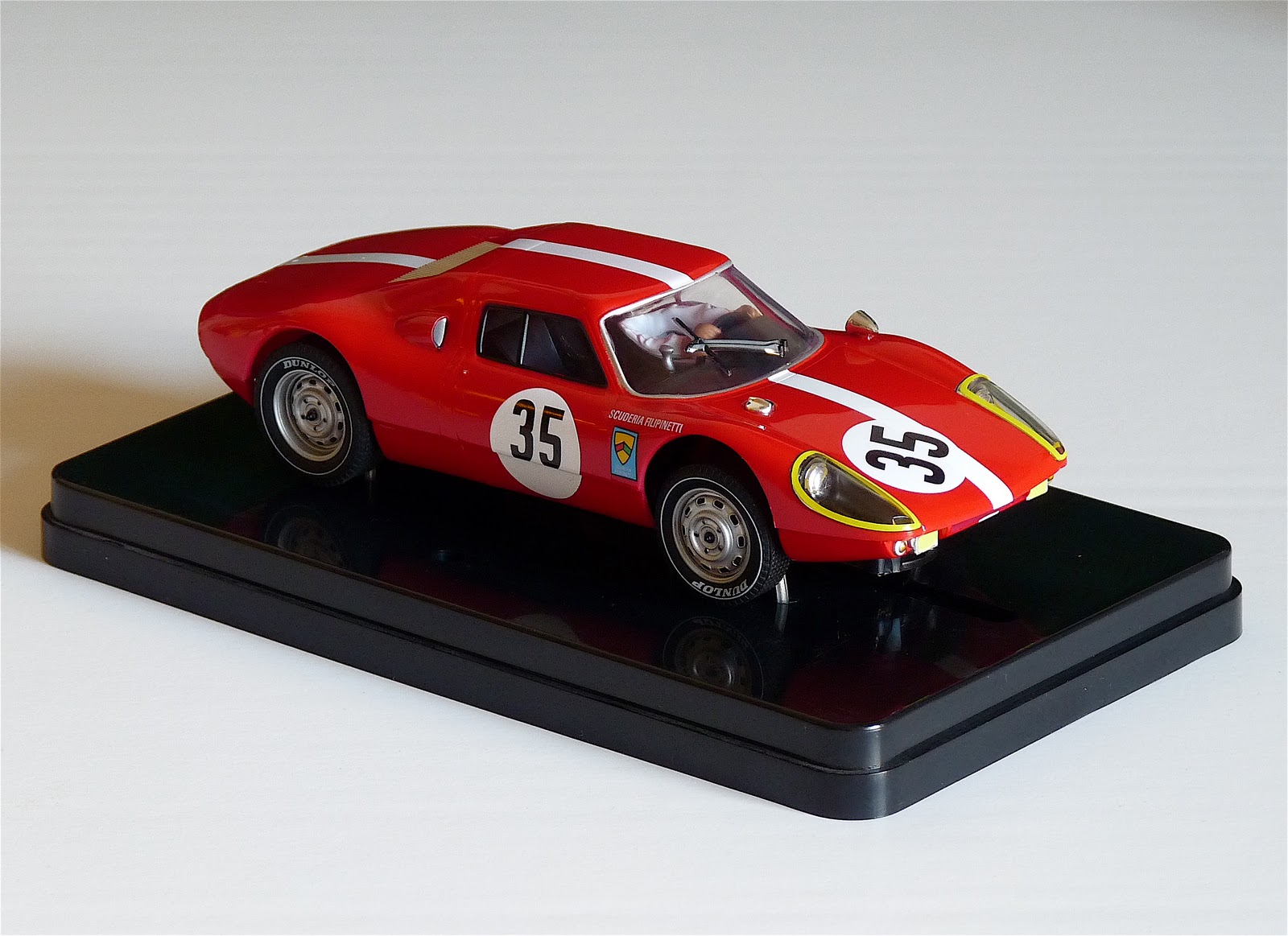 5. #21 Porsche 904 GTS (H Eugster) 035 Hansueli Eugster (CH) 5.GT2 93 laps 6. #12 Alfa Romeo Giulia TZ1 (S Moser) 750 009 Silvio Moser (I) 6.GT2 92 laps 7. #7 Alfa Romeo Giulia TZ1 (Settecolli) Antonio Nicodemi (I) 7.GT2 88 laps 8. #6 Alfa Romeo Giulia TZ1 (Sc.s.Amb) 750 030 Parmignani/Deserti (I) 8.GT2 88 laps 9. #14 Alfa Romeo Giulia TZ (Nabokov) Nabokov/Galimberti (I) 9.GT2 86 laps 10.#4 Alfa Romeo Giulia TZ1 (Sc.s.Amb) DellaBeffa/Cacciandra  10.GT2 83 laps non-finishers #15 Abarth-Simca 2000GT (Abarth) Franco Patria (I) GT2 52 laps #28 Abarth-Simca 2000GT (private) "Tiger" (I) GT2 34 laps #18 Abarth-Simca 2000GT (Abarth) Herbert Demetz (I) GT2 21 laps #22 Porsche 904 GTS (G Ligier) 020 Guy Ligier (F) GT2 16 laps #16 Abarth-Simca 2000GT (Abarth) Luigi Taramazzo GT2 12 laps #18 Abarth-Simca 2000GT (Abarth) Nino Vaccarella (I) GT2 0 laps |
 |
Responsible for the design of the GRP body was Ferry 'Butzi' Porsche, grandson of Ferdinand Porsche. He used some cues and the windscreen of the 718 Coupe and turned it into one of the best looking cars ever constructed. Production of the body was outsourced to airplane manufacturer Heinkel, who were able to produce two bodies per day, which was twice as fast as Porsche could produce the chassis. The body was bonded on the frame, which resulted in a chassis far more rigid than the spaceframe chassis used in the previous racers. Notice crack on rear trunk lid. This was due to aggressive racing. My heart shrank.  At the start of the project the engineers planned on using Porsche's all new two litre flat 6 engine, which was designed for the upcoming 901/911 model. Unfortunately, the engine's development was hampered and it was not ready yet in time for the 100 example production run. As a stop gap, the four cylinder engine from 356 Carrera 2 was uprated to produce 180 bhp in race trim. It retained the unique shaft driven overhead camshafts. Bolted directly on the 'old' engine was a new five speed gearbox, which was also developed for the new road car.  Offering from SCUDERIA FILIPINETTI Three prototypes were constructed and tested heavily in the fall of 1963. After various modifications were carried through, the car was first shown to public late in November. Internally it was known as the '904', but it was marketed to the public as the 'Carrera GTS'. Today it's commonly referred to as the 904. Within two weeks all but 21 of the 90 examples available for the public were spoken for. Production started soon after in a completely new factory, constructed to produce the new 901/911 model. By April of 1964 enough examples were constructed to homologate the 904 as a GT. |
 |
Monza 1964  Although it took until April for the cars to be homologated, the cars were already entered in various races. At Sebring the Lake Underwood and Briggs Cunningham driven 904 finished 9th overall and 1st in the prototype class. This was the start of a highly successful racing career, with overall victory in the Targa Florio and many class victories in races like the 24 Hours of Le Mans. Underlining the car's versatility was a second place finish in the snow covered 1965 Rallye Monte Carlo. Throughout 1964 Porsche continued to develop the 904 and provided their customers with various new parts to keep the cars on the pace. Two of the works cars were fitted with a two litre version of the Formula 1 racers eight cylinder engine and later in the year the six cylinder engine finally made its introduction. These versions were not built in sufficient quantities to be homologated, so they raced in the prototype class only. Larger ducts for cooling the bigger rear brakes is an exterior feature of the 904/6. It was eventually replaced in 1966 by the 906 prototype racer. Today the 904 or Carrera GTS remains as one of the finest and most successful Porsches ever constructed. It kickstarted a program of racing cars, that would eventually result in the all conquering 917. It also holds a unique spot in the manufacturer's history as the last dual-purpose sportscar Porsche ever built. |
Revell Monogram Collectors Edition of the 1954 Porsche Mille Miglia

The Revell Monogram 1954 Porsche Spyder Mille Miglia
 |
The Porsche 550 was a sports car produced by Porsche from 1953-1956. Inspired by the Porsche 356 which was created by Ferry Porsche, and some spyder prototypes built and raced by Walter Glöckler starting in 1951, the factory decided to build a car designed for use in auto racing. The model Porsche 550 Spyder was introduced at the 1953 Paris Auto Show. The 550 was very low to the ground, in order to be efficient for racing. In fact, former German Formula One racer Hans Herrmann drove it under closed railroad crossing gates during the 1954 Mille Miglia. The 550 / 1500RS or Spyder became known as the "Giant Killer". The later 1956 evolution version of the model, the 550A, which had a lighter and more rigid spaceframe chassis, gave Porsche its first overall win in a major sports car racing event, the 1956 Targa Florio. Its successor from 1957 onwards, the Porsche 718, was even more successful, scoring points in Formula One as late as 1963. A descendant of the Porsche 550 is generally considered to be the Porsche Boxster S 550 Spyder; the Spyder name was effectively resurrected with the RS Spyder Le Mans Prototype. The Porsche 550 "Little Bastard" is best known for being the car in which James Dean was killed on September 30, 1955 |
 |
The 550 is among the most frequently reproduced classic automobiles, like the AC Cobra and Lotus Seven. Several companies have sprung up in the last 25 years, some of which build near-exact replicas from the ground up, including spaceframes built to exacting specs from Porsche blueprints. Some of the companies that make replicas are Boulder Speedster, Chuck Beck Motorsports, Automotive Legends, Chamonix do Brasil, Thunder Ranch, Holmes Motor Company, Le Mans 550 Spyder, Vintage Spyders, and Alloycars, which specializes in exact aluminum re-creations from blueprints. Although 2 units were produced with a modified OHV Volkswagen engine, Porsche’s "Type 547" engine, designed by Dr. Ernst Fuhrmann was standard fare for all other 550s. The unit was very advanced for its day, as it had four camshafts that were all driven by the crankshaft, helping provide 110 bhp (very strong for a vehicle of such light weight). With the quad-cam engine powering it, the Porsche 550 Spyder was capable of performance very comparable to—and in many cases better than — Ferrari and Jaguar models with larger engines. The particularly rare 356 Carrera model was the only other Porsche vehicle ever to feature this powerplant. Although Porsche had raced with the 356 for several years already, the 550 was distinct in that it was the company’s first purpose-built racecar. The factory succesfully campaigned the 550 in international auto racing, headed by the vehicle’s premier win at the 1954 24 Hours of Le Mans, where it won its class. |
Later that year Porsche began a production run of customer cars, building 90 units in total before replacing the original 550 with the extensively reworked 550A in 1956.
Here is a car that is probably worth millions of dollars today, its the 1953 Porsche 550 Spyder which was first unveiled at the Paris Auto Show that year. It was developed because Porsche needed a race car more powerful than the Porsche 356. It features a lightweight aluminum body and is powered by four-cam Carrera flat four cylinders.
In 1956, Porsche started to produce the 550A, a slightly modified Spyder. It was a hit, shocking the entire world by winning in its first Appearance in Targa Florio, a brutal road race. It also humbled well-known and more powerful rivals such as Ferrari, Maseratti and Jaguar.
 |
| As their first dedicated sports racing car, the 550 RS Spyder was raced to Porsche's first major victory at the grueling 1956 Targa Florio. This early success marked the arrival of Porsche's dedicated race car program, one which went on to win more races than any other manufacturer and largely fueled Porsche's ongoing commercial success. At the 1953 Paris Motor show, everyone got a first glimpse of the production worthy 550. It's simplistic lines, scant interior, tiny windscreen and purposeful engineering left little doubt towards the intended nature of the car. It was a refined, lightweight and agile race car meant to outclass the heavier, less forwarding thinking competition. And it worked. The 550 was built around a simple tubular ladder chassis covered by a taught aluminum body refined Erwin Komenda from the early prototypes. Sitting near the center of this was a complex engine which Ernst Fuhrmann designed to make the most of the 1.5 liters provided. |
 |
| Schubladenmotor Designated the Type 547, Fuhrmann's engine sat at the forefront of Porsche performance for over ten years. Since its inception, the unit has pained every mechanic being somewhat over engineered and overly complex. The Type 547 uses the same 4-cylinder boxer layout from the 356, but in an entirely different way. To achieve maximum efficiency, the valvetrain uses a complex system of bevel gears and camshafts to offer a true DOHC setup per cylinder bank. This so-called 4-cam setup was exceptionally difficult to setup but allows for domed pistons and a better combustion chamber shape. Futher adding complexity to the unit is a dual-plug ignition system that uses twin distributors of the intake cam. Both circuits could be controlled by levers from the cockpit. The engine also introduced a dry-sump lubrication system which was fed by a tank behind one of the rear wheels. This made the aluminum block relatively small and light. The engine gets it name from the distinctive double-sided cooling fan surrounded by an elegant shroud. |
 |
| Racing With it's exceptional power to weight ratio, the 550 easily won its 1500cc class at the top level of motor sport including a signature class win at 1954 Carrera Panamericana. Afterwards, all cars featuring the Fuhrmann flat-4 were named Carrera in honor of this victory. Years later, the 550 would score its most remarkable feat by taking its first overall win at the 1956 Targa Florio, which was also the first major victory for a mid-engine sports car. Racing accomplishments aside, the 550 was probably best known as the car of choice for cultural icon James Dean. He tragically died in his, at a young age, which piqued general interest for both him and the car. Supposedly, his car was cursed and many people involved with the remaining wreck had misfortune until it vanished into obscurity. With Dean's mystery, the multiple class victories and the recent relaunch of Porsche's mid-engine roadster (the 1998 Boxster), the 550-era was easily the most defining era for Porsche history. In 1956 the car was updated to the 550A specification with a space frame chassis and better engine, before being replaced entirely by the 718. |
Engineers, Ernst Fuhrmann
Engine:
Air-Cooled, Type 547 Flat-4 w/Dry Sump Lubrication position Mid,
Longitudinal aspiration Natural valvetrain DOHC, 2 Valves per Cyl
Fuel feed
Twin Solex PJJ Carburetors
Displacement 1498 cc / 91.4 in³ bore 85 mm / 3.35 in stroke 66 mm / 2.6 in
Compression 9.5:1 power 82.0 kw / 110 bhp @ 6200 rpm specific output
73.43
Bhp per litre bhp/weight
200.0 bhp per tonne torque 120 nm / 88.5 ft lbs @ 5000 rpm body /
Frame
Aluminum Body over Steel Ladder-Type Frame driven wheels
Drive RWD
Front brakes Drums, Rear brakes Drums
Steering Worm & Nut
Front Suspension
Twin Paralel Arms w/Transverse Torsion Bars
Rear Suspension
Swing Axles w/Torsion Bars, Telescopic Shock Aborbers
Weight
550 kg / 1213 lbs
Wheelbase
2101 mm / 82.7 in front track 1290 mm /
50.8 in rear track 1250 mm / 49.2 in length 3600 mm /
141.7 in width 1540 mm / 60.6 in height 1050 mm / 41.3 in
Transmission
4-Speed Manual
Top speed ~
220.5 kph / 137 mph
Designers
Erwin Komenda
Subscribe to:
Posts (Atom)